
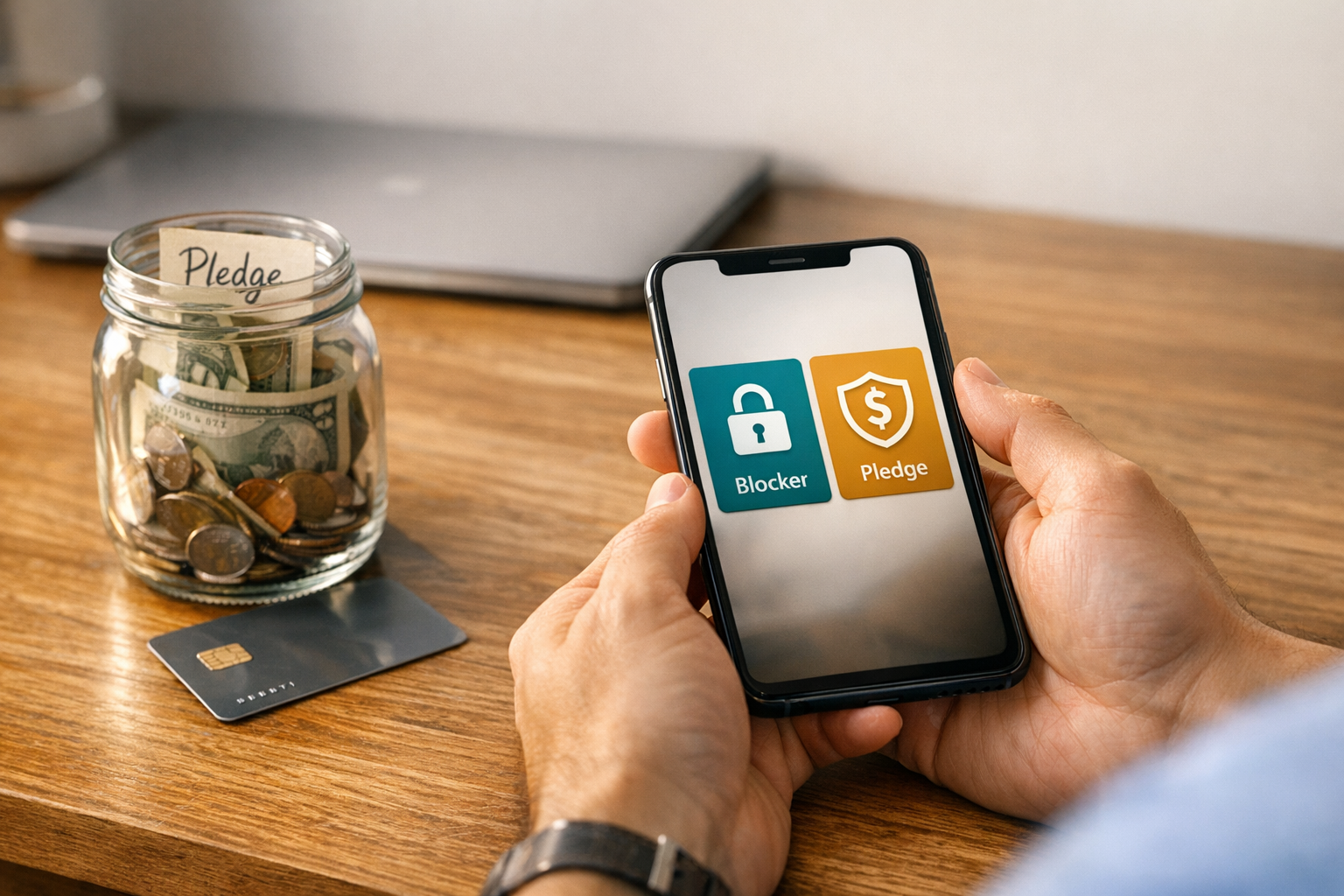
Financial Accountability vs. Traditional Porn Blockers
Breaking free from porn addiction often requires more than just blocking access to explicit content. While standard porn blockers create barriers using technical methods like DNS filtering and AI detection, they often fail to address the deeper psychological reasons behind the behavior. Financial accountability tools, like Pledgely, offer an alternative by introducing monetary consequences for disabling the blocker, leveraging loss aversion to reinforce better choices.
Key Takeaways:
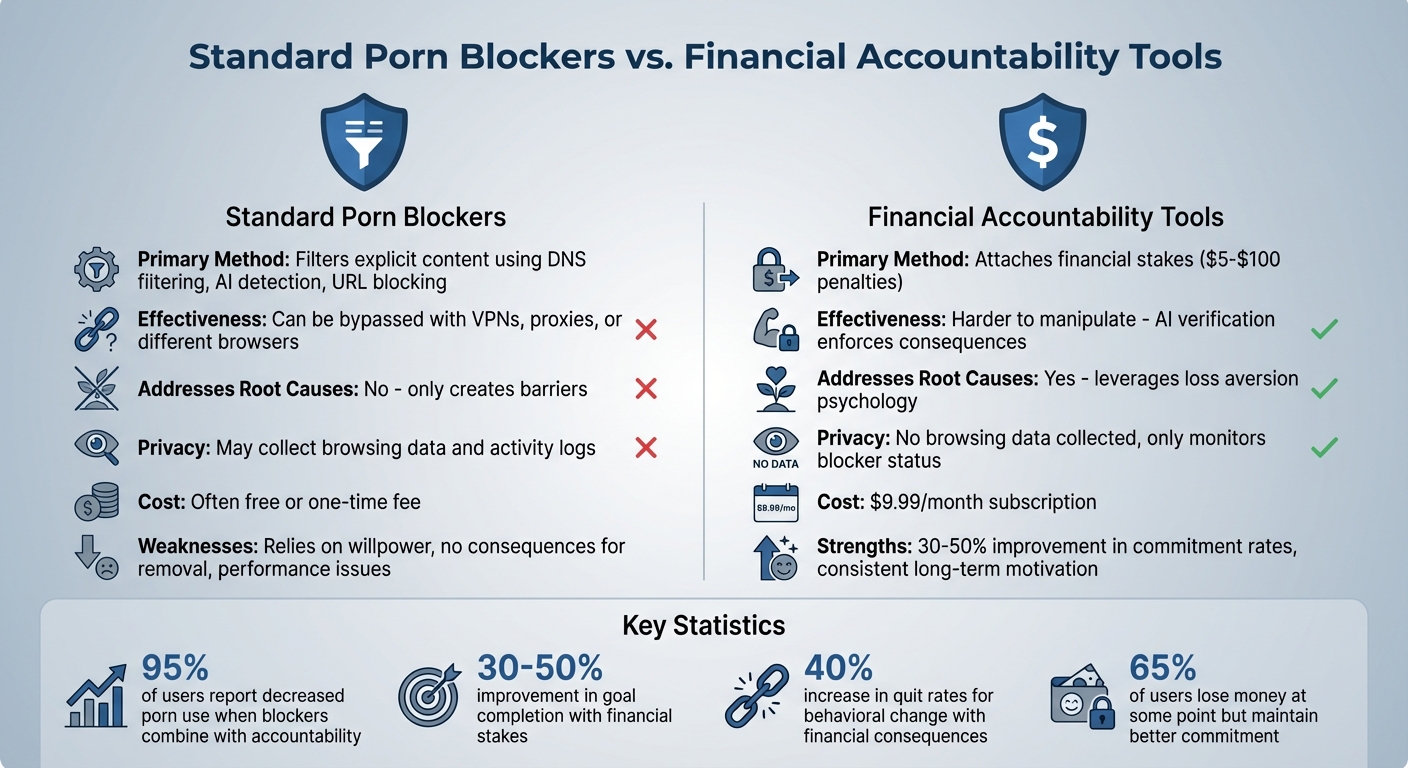
- Standard Porn Blockers: Rely on filters to block explicit content but can be bypassed with VPNs or proxies and don't tackle root causes.
- Financial Accountability Tools: Use financial penalties (e.g., $5-$100) to discourage relapses, addressing behavior directly and promoting long-term change.
Quick Comparison:
| Feature | Standard Porn Blockers | Financial Accountability Tools |
|---|---|---|
| Primary Method | Filters explicit content | Attaches financial stakes |
| Effectiveness | Can be bypassed | Harder to manipulate |
| Addresses Root Causes | No | Yes |
| Privacy | May collect browsing data | Avoids tracking activity |
| Cost | Often free or one-time fee | $9.99/month subscription |
If traditional blockers haven't worked for you, financial accountability tools might provide the structure and motivation needed for recovery.
How to Quit Porn - 12 Science-Based Strategies for Porn Addiction
How Standard Porn Blockers Work
Standard porn blockers are designed to intercept and filter explicit content using a mix of technical methods. One common approach is DNS filtering, which checks website requests against a database of flagged adult domains. If a match is found, the connection is blocked. More advanced tools incorporate machine learning algorithms to analyze websites and images, allowing them to automatically classify new content instead of relying on outdated, manually curated lists. Some blockers even use AI image detection to scan and blur explicit images on social media apps and browsers before they appear on your screen. These methods are often combined with device-specific solutions for broader protection.
Device-based blockers take a more targeted approach. Instead of blocking an entire domain (like reddit.com) as DNS filters might, they use URL and keyword filtering to restrict specific subdomains or threads flagged by certain keywords. Many also enforce SafeSearch on search engines, filtering out explicit results like images and videos. This layered approach aims to provide more nuanced control over what content gets blocked.
Main Features of Standard Porn Blockers
Standard porn blockers often come with features that make them easy to use and versatile across devices. For instance:
- Simple setup: Many blockers are available as one-click browser extensions or mobile apps that work across multiple devices.
- Parental controls: These tools frequently include options like screen time limits and activity monitoring.
- Tamper resistance: To prevent easy removal, they may require a PIN or impose a waiting period before deactivation.
- Whitelisting modes: Some blockers can default to blocking all internet access, requiring manual approval for each safe website.
- Network-wide protection: DNS filtering at the router level can safeguard every device connected to your home Wi‑Fi without needing individual installations.
These blockers typically operate passively, acting as gatekeepers that filter content without involving the user in the decision-making process. As digital wellness experts point out:
Willpower is a finite resource and having the option to browse an unfiltered internet can be draining on your willpower because you're consistently restraining yourself.
While these tools are effective at setting boundaries, they don't address the underlying behaviors that accountability systems aim to tackle.
Where Standard Porn Blockers Fall Short
Despite their benefits, standard porn blockers have notable limitations that often lead users to seek more robust solutions. For one, VPNs and proxies can bypass DNS filtering by rerouting traffic through alternative servers. Similarly, users can simply switch to mobile data if the blocker is Wi‑Fi-dependent or use a different browser that doesn't have the extension installed.
Performance issues are another drawback. Some blockers can slow down devices, making them feel sluggish or less responsive. Additionally, because these tools focus solely on restricting access, they lack mechanisms to create external accountability. Without consequences or oversight, determined users can often find workarounds, undermining the effectiveness of these blockers.
What Financial Accountability Is and How Pledgely Works
Financial accountability takes a different approach from traditional blockers by introducing real-world consequences through financial stakes. This approach taps into loss aversion, a psychological principle that makes people more motivated to avoid losing money than to gain it. Studies show this method can improve commitment rates by 30%–50% compared to simply tracking behavior alone[1]. Unlike typical blockers that just restrict access, turning off a system like this comes with an immediate financial penalty. For example, smoking cessation studies have shown a 40% increase in quit rates when financial stakes are involved[1]. Even though about 65% of people using financial stakes for health goals lose money at some point, they still stick to their commitments more effectively than those without this system[1]. This is the foundation of what Pledgely provides.
What Pledgely Offers
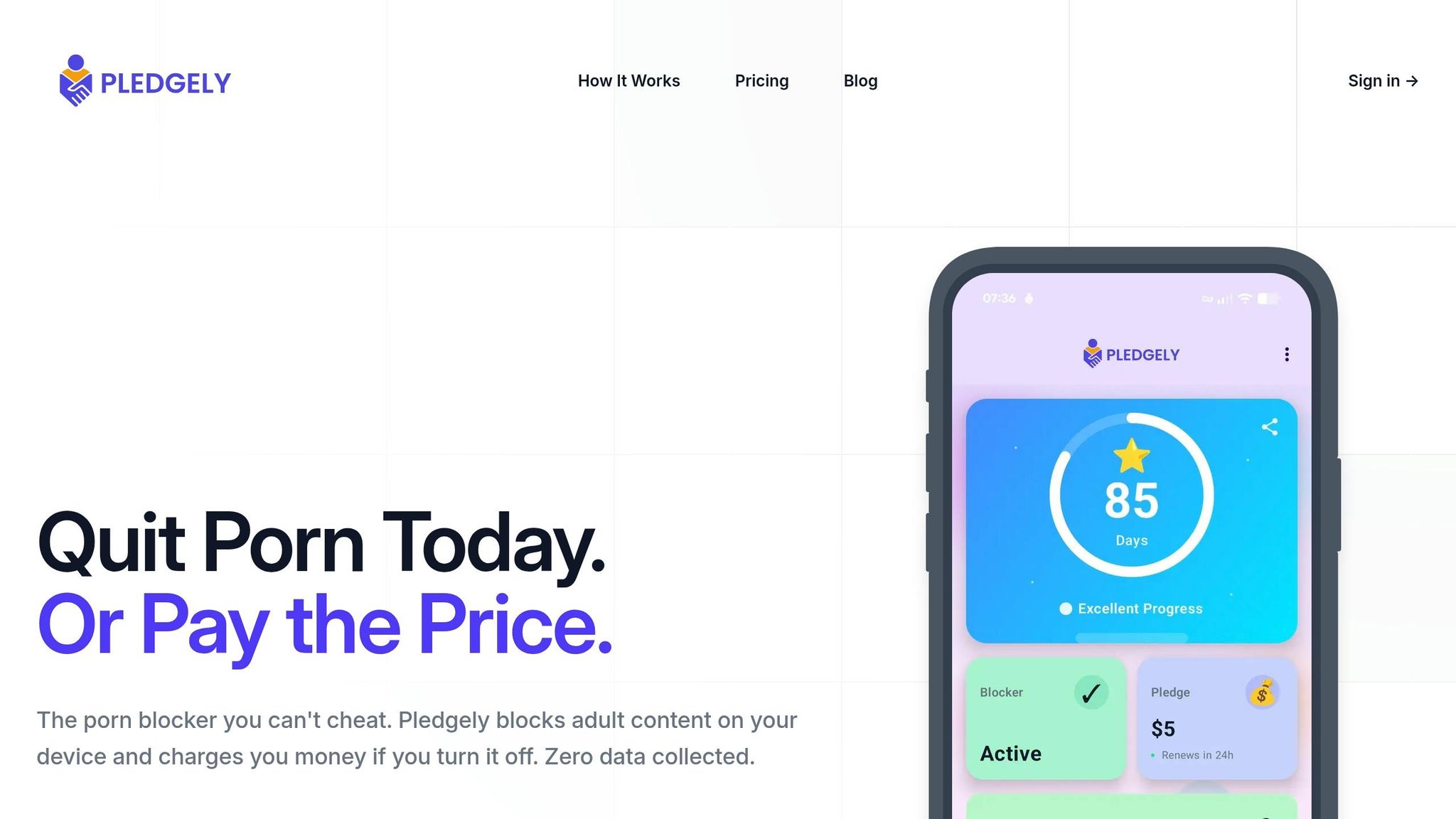
Pledgely combines financial accountability with content filtering in a way that prioritizes privacy and effectiveness. The app uses a locally stored blacklist to block adult content across apps and browsers, ensuring restricted material doesn't load. Importantly, it doesn't track or collect browsing data - no URLs, domains, or activity logs are stored. Instead, it monitors only whether the blocker is active. If the blocker is turned off, the app enforces accountability by triggering a financial pledge you've set, which can range from $5 to $100. Pledgely operates on a subscription model at $9.99 per month and supports multiple devices. Payments are securely processed through Stripe, and any deactivation of the blocker results in an automatic charge.
How Financial Pledges Create Accountability
The financial pledge system ensures accountability from the moment you start and keeps motivation steady over the long haul. The immediate consequence of losing money serves as a constant reminder, making it just as effective weeks into your recovery as it is on day one. This consistent enforcement is crucial because recovery is a long-term process, and motivation naturally ebbs and flows. Pledgely's system helps bridge those moments of low motivation, ensuring you stay on track.
Financial Accountability vs. Standard Porn Blockers
Strengths and Weaknesses Compared
Standard porn blockers rely on technical filters to block access to certain content, while financial accountability takes a different approach: it taps into loss aversion. This psychological principle highlights that people are often more motivated to avoid losing money than they are to gain something.
The downside of standard blockers is their vulnerability to circumvention. VPNs, incognito browsing, and other simple workarounds can often render them ineffective. Research on problematic pornography use suggests that interventions targeting underlying psychological mechanisms — not just access restriction — are more effective at producing lasting change [2]. As many recovery experts note:
Porn blockers are a critical first line of defense, but they work best as part of a larger system that includes accountability and bypass prevention.
This is where financial accountability tools step in. These tools use AI to verify behavior and enforce financial penalties, eliminating the reliance on self-reporting. Unlike filters that only block access, financial accountability tackles the behavior itself. A monetary penalty - whether $5 or $100 - acts as a consistent and effective deterrent, leveraging the discomfort of financial loss to reinforce better choices.
Privacy is another critical factor. Standard blockers that operate locally offer strong privacy but can sometimes slow down devices. On the other hand, monitoring apps that share screenshots or browsing history with accountability partners often feel invasive. Tools like Pledgely strike a balance by avoiding browsing data collection or requiring human partners. Instead, they automatically ensure the blocker is active and enforce financial consequences without compromising privacy.
These differences highlight why financial accountability tools are uniquely positioned to address both the technical and psychological aspects of recovery.
Why Financial Accountability Works Better Over Time
Financial accountability has a unique advantage: it promotes long-term behavioral change. Standard blockers, while effective at creating barriers, don't address the underlying addiction. When motivation dips, users often find ways to bypass these tools.
Financial accountability introduces a meaningful pause in decision-making. By attaching financial consequences to actions, it re-engages rational thinking even in moments of strong temptation. Research on commitment devices shows that they significantly boost goal completion rates, largely because they maintain motivation over time [1]. Unlike blockers, which can sometimes become a game to outsmart, financial accountability shifts focus to protecting personal finances.
This approach avoids external monitoring or social pressure, making it a more private and self-driven method. With financial accountability, you're not just relying on willpower - you're creating a system where both your wallet and your personal values work together to support recovery.
Conclusion: Picking the Right Recovery Tool
Standard blockers often act as surface-level solutions, easily sidestepped through methods like VPNs or simple uninstallation. This exposes their limitations and underscores the importance of tools that enforce more concrete consequences.
Financial accountability tools, such as Pledgely, take a different approach. With a subscription cost of $9.99/month and pledge amounts ranging from $5 to $100, they leverage the concept of loss aversion to encourage meaningful change. This method has been shown to improve goal completion rates by 30% to 50% [1]. Additionally, Pledgely uses AI verification to minimize the chances of manipulation, ensuring the system remains effective.
Choosing the right tool depends on your personal recovery journey. If traditional blockers haven't worked for you, the tangible consequences provided by financial accountability tools could offer the reinforcement you need - particularly if you face challenges like ADHD or difficulties with executive functioning [1].
Consider your past experiences carefully: while standard blockers can help reduce accidental exposure, financial accountability tools align your financial commitments with your recovery goals, offering a more structured path forward.
FAQs
Will I be charged if I accidentally turn off the blocker?
Yes, turning off the blocker will result in a fee. This policy is designed to promote financial accountability and motivate users to stick to their goals.
How does Pledgely block content without tracking my browsing?
Pledgely stops content directly on your device by using a locally-stored blacklist. This approach ensures that no browsing data or URLs are collected or sent anywhere, keeping your activity entirely private and unmonitored.
What pledge amount should I choose to actually stay accountable?
A suggested pledge of $15 per month or more can serve as a meaningful financial commitment. This amount not only helps reinforce your goals but also encourages consistent behavior by adding a sense of accountability.