
Porn Blockers vs Willpower: What Actually Works
When it comes to quitting porn, the big question is: should you depend on willpower or use porn blockers? Here's the short answer: a combination of both works best.
- Willpower helps you resist urges but is limited and weakens under stress or fatigue.
- Porn blockers act as a safety net by restricting access to explicit content, but they don't address deeper emotional triggers.
- Together, blockers reduce temptation while you work on building healthier habits and addressing the root causes of addiction.
For long-term success, pair blockers with strategies like therapy, mindfulness, and lifestyle changes. This dual approach creates a stronger path to recovery without relying on sheer willpower alone.
How Porn Blockers Work
How the Technology Works
Porn blockers rely on multiple layers of technology to prevent access to adult content before it even loads. One of the most effective techniques is DNS filtering, which works at the network level by identifying and blocking adult domains. This approach ensures protection across all devices connected to your home Wi-Fi network [4].
Modern tools have advanced beyond simple blocklists. Many now use AI to analyze images and text in real time, detecting explicit content on social media and other platforms [4]. Some blockers take a stricter approach by using whitelisting - blocking the internet entirely until specific sites are manually approved [4]. Additional features often include SafeSearch enforcement, PIN protection, and delayed deactivation to prevent impulsive bypassing [4]. The American Academy of Pediatrics endorses DNS-based filtering tools for their ability to provide comprehensive, network-wide protection [4].
Advantages of Porn Blockers
Porn blockers help break the cycle of instant gratification by eliminating access to explicit content. This can be especially helpful during high-risk times, such as late at night, during stressful periods, or when withdrawal cravings are strongest. Many blockers also offer accountability features, like monitoring screen activity and sending real-time reports to an accountability partner. Research suggests that users who pair blockers with accountability experience a significant reduction in porn use [3].
Customization is another advantage. Users can tailor settings to their needs, such as scheduling restrictions during specific hours or filtering out particular triggers. This personalization allows individuals to create a recovery environment that works for them [4].
Drawbacks of Porn Blockers
While porn blockers provide valuable support, they aren't foolproof. Tech-savvy users can bypass them using VPNs, proxy servers, or simply switching from Wi-Fi to mobile data when DNS filtering is in place [4]. Another common issue is over-blocking - some tools mistakenly restrict access to harmless websites due to mild lewd language, which can be frustrating for everyday browsing [3]. Additionally, certain blockers may cause devices to run slower, which can be frustrating [3].
However, the biggest limitation isn't technical. As many experts in the field point out:
Content filters are not absolute solutions, rather they should be looked at as deterrents and complementary controls [4].
Similarly, addiction researchers warn:
Porn blockers simply shield you from porn without dealing with the root problem. Blockers alone don't free you from porn addiction [3].
Without addressing deeper issues like stress, loneliness, or trauma, relying solely on blockers can lead to "bondage swapping", where external controls take the place of true internal growth [6]. For lasting recovery, experts recommend combining blockers with broader strategies like therapy, support groups, and lifestyle changes. This integrated approach often delivers better long-term results and highlights the importance of addressing the root causes of addiction.
The Role of Willpower in Recovery
What Willpower Means for Addiction Recovery
Willpower is the mental strength that helps you resist cravings and make decisions aligned with your recovery goals. It's powered by your prefrontal cortex, the brain region responsible for planning, decision-making, and impulse control. Each time you resist a craving, you're engaging this part of your brain to override the automatic, habitual responses driven by the limbic system [8].
However, willpower isn't unlimited. Each act of self-control takes a toll, gradually depleting your mental reserves. As the Center for Sex, Porn and Masturbation Addiction explains:
Willpower is not designed to sustain long-term change. It's like a muscle - if you overuse it, it fatigues. [1]
This explains why urges often feel harder to resist at the end of a stressful day or late at night - your willpower reserves are running low. Recovery isn't about relying on superhuman self-control. Instead, it's about understanding the limits of willpower and creating strategies to avoid constantly battling cravings head-on. Without these strategies, the natural depletion of willpower leaves you vulnerable to the automatic, ingrained behaviors that addiction reinforces.
Why Willpower Alone Often Fails
When your mental reserves are drained, addiction's deeply rooted pathways can take over. Addiction rewires the brain, building automatic habit loops stored in procedural memory - the same memory system that allows you to ride a bike without thinking about it. These circuits can activate unconsciously, triggered by specific emotions, environments, or even times of day, often before you're fully aware of what's happening [8].
Stress and exhaustion further weaken the prefrontal cortex, giving the limbic system the upper hand. Research published in Nature Reviews Neuroscience reveals that chronic stress reduces the prefrontal cortex's ability to function while amplifying impulsive, habitual behaviors [8]. Ironically, the moments when you need willpower the most - when you're feeling anxious, tired, or overwhelmed - are the moments when it's least effective.
Addiction also creates a disconnect in the brain between "wanting" and "liking." Over time, the craving system becomes more powerful, even as the actual pleasure from the addictive behavior diminishes. This imbalance forces your willpower to battle intense urges for something that may no longer bring you real satisfaction [2].
Relying solely on determination, often referred to as "white-knuckling", tends to backfire. Suppressing urges without addressing the emotional roots of addiction can increase cortisol (the stress hormone) and lead to "rebound cravings", where the urges return even stronger [8]. As Passages Malibu emphasizes:
Addiction is not a failure of will. It is a biological and emotional conditioning process - one that cannot be undone through discipline alone. [8]
This underscores the need for a more comprehensive approach to recovery. Instead of relying solely on willpower, effective strategies include creating supportive environments, developing emotional regulation skills, and making lifestyle changes that address the deeper causes of addiction. These methods help reduce the reliance on willpower and pave the way for lasting change.
Combining Blockers with Behavioral Strategies
Using Environmental Controls to Support Recovery
Pairing porn blockers with thoughtful changes to your environment can make a big difference in recovery. The idea is to create a setting that naturally reduces exposure to triggers, making healthier choices easier and temptation harder to access.
One effective tactic is to introduce friction between you and pornography. For instance, keep devices in public spaces and charge your phone in a separate room overnight. These small adjustments can limit privacy and disrupt automatic habits that often lead to relapse [2]. When combined with blockers, these changes don't just filter content - they actively prevent the conditions that enable habitual behavior.
Another approach is to redirect your time during moments when you're most vulnerable. Schedule specific activities during high-risk periods, like attending a late-evening exercise class, meeting a friend for coffee, or spending time in shared spaces until you're ready to sleep [2]. These strategies aren't about resisting the urge directly. Instead, they change your surroundings in ways that weaken the urge's grip.
To take this even further, adding accountability and making lifestyle changes can solidify your recovery framework.
Adding Accountability and Lifestyle Changes
Using blockers alongside accountability systems can boost their effectiveness. Many tools are designed to notify a trusted person - like a friend, partner, or therapist - if you try to access restricted content or tamper with the software [3]. For a stronger safeguard, you might even let an accountability partner manage the blocker settings, ensuring you can't bypass the system during moments of impulsiveness [9].
Recovery also requires tackling deeper emotional triggers. Cognitive Behavioral Therapy (CBT) can help you identify and address feelings like stress, loneliness, or anxiety that might fuel the urge to use pornography [7]. Mindfulness practices, on the other hand, encourage you to observe these urges without acting on them, allowing them to fade naturally over time [2]. This method doesn't repress the urge but helps you see it as temporary and manageable.
Sustained recovery often involves replacing addictive habits with healthier, more fulfilling activities. Whether it's regular exercise, exploring new hobbies, or engaging with your community, these alternatives provide positive outlets for your energy and attention [2].
The Center for Sex, Porn and Masturbation Addiction sums it up well:
Recovery isn't about trying harder. It's about setting yourself up for success so you don't have to rely on sheer force of will. [1]
7 Things Men Try To Quit Porn… That Never Work (And What Actually Does)
Choosing the Right Approach for Your Recovery
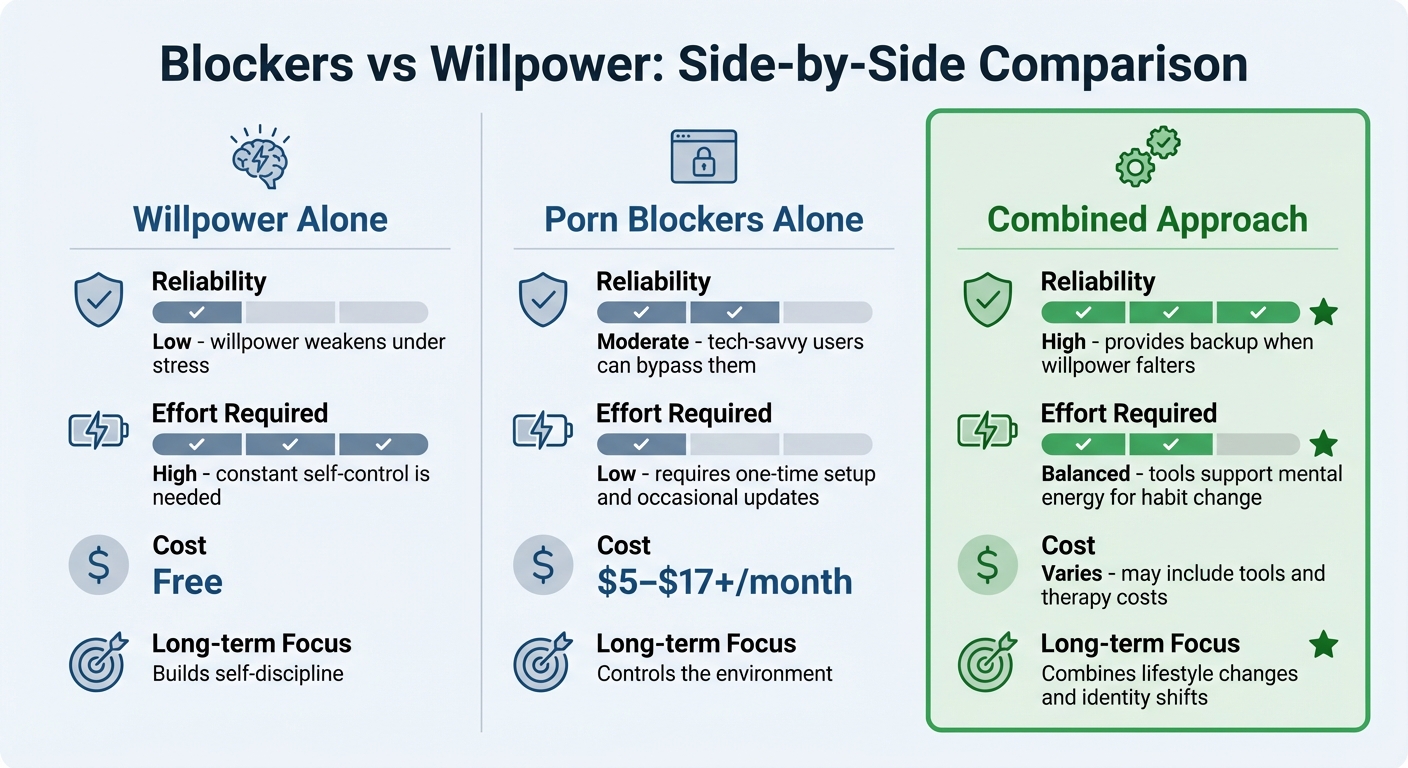
Blockers vs Willpower: Side-by-Side Comparison
Understanding the differences between blockers and willpower can help you craft a recovery plan that sticks. Here's a breakdown of how each approach measures up:
| Feature | Willpower Alone | Porn Blockers Alone | Combined Approach |
|---|---|---|---|
| Reliability | Low; willpower weakens under stress [1] | Moderate; tech-savvy users can bypass them [10] | High; provides backup when willpower falters [10] |
| Effort Required | High; constant self-control is needed [10] | Low; requires a one-time setup and occasional updates [10] | Balanced; tools support your mental energy for habit change [1] |
| Cost | Free | $5–$17+/month [3] | Varies; may include tools and therapy costs [3] |
| Long-term Focus | Builds self-discipline | Controls the environment | Combines lifestyle changes and identity shifts [1] |
Blockers are like a 24/7 safety net - they don't tire out. However, they won't address the emotional and psychological triggers behind addictive behaviors [9]. On the flip side, relying solely on willpower often leads to burnout. The takeaway? You need a strategy that blends both approaches.
What Works for Long-Term Success
The best results come from combining blockers with intentional behavior changes. Blockers serve as your first line of defense while you work on transforming your habits and identity. The goal is to move from saying, "I'm trying to quit", to confidently stating, "I'm the kind of person who doesn't do this" [1].
Start with layered protection: use tools like DNS filtering, device-specific apps, and accountability systems that notify a trusted partner if you attempt to bypass restrictions [9][10]. Premium blockers often combine technical barriers with accountability features, which can lead to significant progress [3].
But recovery isn't just about technology. Replace old habits with healthier alternatives - exercise, hobbies, volunteering, or connecting with others can fill the void. Therapy or mindfulness practices can also help you address emotional triggers [7]. As one digital wellness expert puts it:
Creating a blocking system allows you to rein-in technology habits that contribute to a larger compulsive behavior [10].
The ultimate goal? Build a life where porn simply doesn't have a place anymore.
FAQs
Which porn blocker settings are hardest to bypass?
The toughest porn blocker settings to work around are those that enforce comprehensive restrictions. For example, strict modes that completely block access to adult content leave little room for loopholes. Equally effective are settings that disable proxy sites and VPNs, as they prevent users from sidestepping filters altogether. On the other hand, tools that depend only on monitoring or external accountability tend to be easier to bypass, especially with the use of VPNs or proxy tools.
How do I pick an accountability partner that actually helps?
Choose someone you trust to offer steady, non-judgmental support. This person should be dependable, respect your goals, and remain dedicated to your progress. It's important that they value confidentiality and focus on encouraging you instead of being critical. A good accountability partner will actively participate in your journey, helping to strengthen your determination and providing that extra push to keep you moving forward.
What should I do when an urge hits late at night?
When a late-night craving hits, don't depend entirely on willpower - it tends to be less reliable during those hours. Instead, take a different approach. Start by identifying and removing triggers that might spark the urge. Practicing mindfulness can also be helpful; it allows you to observe the craving without immediately reacting to it. Another option is to switch up your environment or engage in a different activity to redirect your focus. Establishing calming routines, like reading a book or listening to soothing music, can work wonders too. These methods are often more effective than simply trying to resist the temptation head-on.