

Does Quitting Porn Improve Your Brain Function?
Quitting porn can significantly improve your brain’s ability to focus, make decisions, and manage emotions. Research shows that stopping porn use allows your brain to recover from dopamine overstimulation, which often leads to issues like brain fog, poor memory, and impulsivity. Here’s what happens when you quit:
- Improved focus and memory: Attention can increase by 17% within 8 weeks, and working memory strengthens.
- Better emotional health: Anxiety and depression symptoms drop by up to 24% after six months.
- Restored dopamine sensitivity: Everyday activities become enjoyable again as dopamine receptors normalize in 3–4 weeks.
- Enhanced impulse control: The prefrontal cortex regains strength, helping you resist urges and make thoughtful decisions.
Although the initial withdrawal phase can be challenging, these changes are signs of recovery. Tools like accountability apps, mindfulness, and therapy can support the process. The benefits of quitting extend beyond mental clarity - users often report improved productivity, relationships, and overall well-being.
Ready to reclaim your focus and emotional balance? Start today.
How Pornography Changes Your Brain
What Happens to Your Brain When You Watch Porn
Let’s dig deeper into how pornography affects the brain by rewiring its neural circuits. This process involves neuroplasticity - the brain’s ability to adapt and reorganize itself - but in the case of pornography, these changes often promote patterns linked to addiction. Psychiatrist Norman Doidge explains:
Pornography satisfies every one of the prerequisites for neuroplastic change. When pornographers boast that they are pushing the envelope by introducing new, harder themes, what they don't say is that they must, because their customers are building up a tolerance to the content [3].
This tolerance grows because pornography delivers powerful bursts of reward, reinforcing neural pathways that prioritize porn over natural experiences like real intimacy or social bonding. Research from the Max Planck Institute highlights that frequent porn consumption reduces brain responsiveness to typical sexual images, signaling desensitization and a need for more extreme material [3]. Brain scans of regular users even reveal structural changes, such as reduced gray matter in areas like the right caudate and prefrontal cortex [1].
These changes don’t just stay confined to the brain’s structure - they also impact how the reward system functions, as we’ll explore next.
Dopamine and the Reward System
Pornography floods the brain with dopamine, creating surges far stronger than those triggered by natural rewards. Over time, this overstimulation causes dopamine receptors to downregulate, which dampens the pleasure from everyday experiences while amplifying cravings for more porn. Researchers describe this as a "wanting versus liking" split [3]: the desire to seek out porn intensifies, even though the enjoyment it provides diminishes.
Additionally, porn can weaken the connection between the prefrontal cortex, which governs self-control and decision-making, and the limbic system, which drives impulses. This weakening - referred to as hypofrontality - reduces impulse control and leaves the brain less equipped to manage emotions, often reverting to a more immature state [3]. Neuroscience researcher Rachel Anne Barr explains:
The desensitization of our reward circuitry sets the stage for sexual dysfunctions to develop, but the repercussions don't end there. Studies show that changes in the transmission of dopamine can facilitate depression and anxiety [3].
On a molecular level, repeated exposure to high-intensity stimulation causes a buildup of ΔFosB, a transcription factor that lingers in the brain’s nucleus accumbens for weeks. This buildup reinforces compulsive, cue-driven behaviors, making it harder to break free from the cycle of use [3]. These changes underline why recovery requires undoing these deeply ingrained patterns and resetting the brain’s reward system.
Mental and Emotional Effects of Regular Porn Use
Problems with Focus, Memory, and Decision-Making
The brain changes linked to frequent porn use can lead to noticeable struggles in daily life. Many users report experiencing persistent "brain fog" and issues with working memory - like forgetting what they just read or needing to go over material several times to retain it.
Regular porn consumption affects the prefrontal cortex, the part of the brain responsible for planning, organization, and multitasking. Studies have shown a connection between excessive porn use and reduced gray matter in the brain's reward system. This reduction can increase impulsivity and make it harder to weigh long-term consequences against immediate desires.
The effects can be even more pronounced when exposure begins in adolescence. Early exposure has been linked to higher rates of personality and impulse control disorders. In fact, a 2016 study found that 49% of participants admitted to seeking out content they initially found unappealing or even repulsive [5].
These cognitive difficulties often go hand in hand with emotional challenges, which are explored in the next section.
Mood Changes and Withdrawal Effects
Frequent porn use doesn’t just impact cognitive abilities - it also takes a toll on emotional health. Regular exposure can lead to dopamine desensitization, leaving users feeling emotionally numb and making everyday activities less enjoyable. Many report increased levels of generalized anxiety, social anxiety, and depression. On top of that, the shame and secrecy surrounding excessive use can push individuals further away from meaningful real-life relationships.
Interestingly, those who quit pornography often see improvements in their emotional well-being. For example, a six-month abstinence period led to a 24% drop in generalized anxiety, a 19% reduction in social anxiety, and a 17% decrease in depression ratings [1]. Another survey of over 1,000 people found that anxiety symptoms began to ease within just 2–3 weeks of quitting [1].
That said, the initial phase of withdrawal can be tough. James, a participant in recovery, shared his experience:
The first two weeks were actually worse than when I was using porn regularly. I couldn't concentrate at all, felt constantly distracted, and was irritable and forgetful [2].
This challenging 14-day withdrawal period, marked by mood swings and irritability, is part of the brain’s process of healing its dopamine receptors. Understanding that these symptoms are temporary and a sign of recovery can provide the motivation needed to stick with the process.
How to Quit Porn - 12 Science-Based Strategies for Porn Addiction
How Your Brain Heals After Quitting Porn
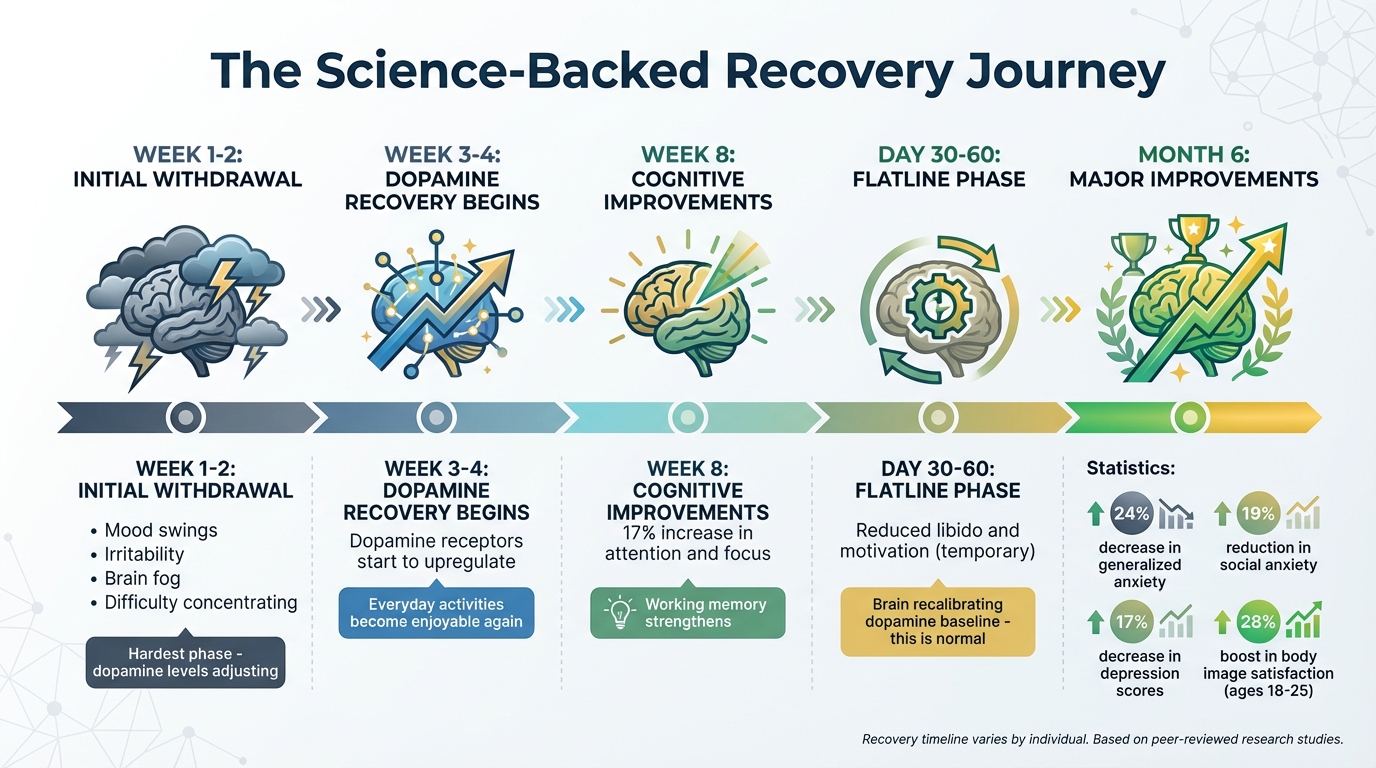
Once you push through the initial withdrawal symptoms like mood swings and brain fog, your brain begins an incredible journey of recovery.
Recovery Timeline: What to Expect
The brain's recovery relies on neuroplasticity, its ability to rewire itself and form new connections. Without the constant overstimulation from pornography, your dopamine receptors start to "upregulate." This means they regain sensitivity, allowing you to enjoy everyday pleasures like hanging out with friends or diving into hobbies again [2][6].
The first two weeks can feel like an uphill battle. As your brain adjusts to the lack of intense stimulation, dopamine levels take a hit, leading to temporary irritability and mental fog. But by weeks 3–4, your dopamine receptors start showing signs of improvement [1]. By the 8-week mark, you may notice better focus and attention, clear indicators of your brain’s recovery.
Your prefrontal cortex, the part of your brain responsible for planning, decision-making, and impulse control, also gets stronger as you break away from the addictive patterns of pornography. Blair Bisher from BPB Counseling Group explains:
The prefrontal cortex - responsible for executive processes like goal-setting, self-regulation, and decision-making... loses its ability to control impulses after prolonged, repeated exposure to pornography. [6]
Between days 30 and 60, many people encounter the "flatline" phase - a temporary period of reduced libido and motivation. Although it might feel discouraging, it’s actually a sign that your brain is recalibrating its dopamine baseline [4]. By 6 months, the changes become even more noticeable, including a 24% decrease in generalized anxiety and a 19% drop in social anxiety [1].
These biological shifts set the stage for broader improvements in both thinking and emotional well-being.
Measured Improvements in Thinking and Mood
As your brain heals, these internal changes start showing up in your day-to-day life. For example, Michael, a law student, struggled to focus for more than 15 minutes due to his reliance on porn. By his second month of recovery in early 2025, he could concentrate for 45 minutes and tackle complex legal concepts again [2]. Alex, a 28-year-old programmer, hit the four-month mark in March 2025 and described how his persistent brain fog lifted, enabling him to solve coding issues faster and maintain focus for hours [2].
Better focus is just the beginning. Many people report increased productivity and a noticeable reduction in procrastination [1]. Cognitive abilities like working memory, processing speed, and planning also improve. Thomas, a neuroscience student, described his experience:
As my dopamine system rebalanced, I noticed my ability to find satisfaction in challenging mental work returned. [2]
The emotional benefits are just as striking. After 6 months, individuals report a 17% decrease in depression scores [1]. Younger adults (ages 18–25) note a 28% boost in body image satisfaction within just 90 days [1]. This recovery isn’t just about healing - it’s about rediscovering the ability to experience joy, make clear decisions, and fully engage with life again.
Practical Steps to Quit Porn and Restore Brain Health
Knowing how your brain heals is just the first step - actually breaking free requires actionable strategies. Combining tools for accountability, effective behavior shifts, and mental health support creates a strong path toward recovery. These approaches align perfectly with your brain's natural recovery process.
Using Accountability Tools and Apps
Financial accountability can be a powerful motivator. Apps like Pledgely offer a simple way to stay on track: you set a financial pledge (anywhere from $5 to $100), and if the blocker is disabled, the app automatically charges you. It filters adult content across all browsers and apps on your device, working locally without collecting your browsing data. For $9.99 per month, it’s currently available on Android, with iOS on the way. Tools like these reduce access to triggers and work hand-in-hand with other behavior change techniques.
Behavior Change Strategies That Work
Accountability tools are just one part of the equation - personal strategies are key to managing cravings and stress. Mindfulness, for example, helps create a pause between feeling an urge and acting on it. As the saying goes, "Between stimulus and response there is a space" [7]. Regular meditation strengthens the prefrontal cortex - the area of the brain responsible for impulse control - making it easier to notice cravings without immediately giving in [7].
It’s also important to identify your personal triggers, such as stress, boredom, or loneliness, and plan specific responses for these moments. During particularly stressful times, try establishing a "Minimum Viable Day" that includes basics like 7 hours of sleep, some light exercise, and 5 minutes of meditation. These small actions help maintain mental resilience [9].
Treating Related Mental Health Issues
Porn use often serves as a way to avoid deeper emotional pain. As the Reborn Method puts it:
You don't have a porn problem. You have a pain problem. Pornography is not the disease. It's the medication [4].
If you’re dealing with anxiety, depression, or unresolved trauma, addressing these issues through therapy - especially Cognitive Behavioral Therapy (CBT) - can make a huge difference in long-term recovery [8]. Traditional CBT typically involves one 60–90 minute session per week over 8 to 12 weeks, helping you replace harmful thought patterns with healthier ones.
Breaking free from shame is another critical step. Shame thrives in isolation, which can fuel addiction. The solution? Connection:
Shame grows in isolation and dies in connection [4].
Whether it’s with a therapist, a support group, or a trusted friend, opening up to someone safe can disrupt this harmful cycle and speed up your brain’s recovery. Tackling these underlying emotional challenges strengthens the progress you’re making toward lasting change.
Signs Your Brain Function Is Improving
When your brain starts to recover, you'll notice clear signs of better mental clarity and emotional balance. These changes often build on earlier progress, showing that healing is well underway.
Mental Performance Improvements
One of the first things you might notice is better focus. Studies reveal that attention and concentration can significantly improve after just eight weeks of abstinence [1]. For example, you might find it easier to read without your mind wandering or finish articles and books without needing to re-read the same section repeatedly.
Working memory also gets stronger. People often report being able to handle complex tasks more effectively and retain information more easily. These improvements often translate into better productivity. Research shows a 28% increase in task completion, a 24% boost in meeting deadlines, and a 32% drop in procrastination [1]. For instance, James, a graduate student, saw his GPA jump from 3.2 to 3.9 after recovery. His professors even noticed a new level of clarity and depth in his academic writing [2].
These mental gains don't just stop at productivity - they also pave the way for better emotional balance and stronger relationships.
Emotional and Behavioral Changes
As your brain heals, you'll likely experience emotional shifts that reflect a healthier reward system. Research indicates a 24% reduction in generalized anxiety and a 17% drop in depression symptoms after six months of abstinence [1]. Thomas, a neuroscience student, described this change perfectly:
As my dopamine system rebalanced, I noticed my ability to find satisfaction in challenging mental work returned [2].
Another major shift is reduced impulsivity. You'll find it easier to make thoughtful decisions without constantly chasing instant gratification. Social interactions also tend to improve - you might feel more "in the moment" during conversations and better at picking up on subtle emotional cues. These changes stem from the prefrontal cortex reclaiming its role in regulating emotions and processing social information [2].
These transformations don’t just enhance cognitive abilities - they also enrich personal well-being. As David, a recovered individual, put it:
The improved relationships and sexual health are important, but honestly, getting my brain back has been the most valuable aspect of recovery [2].
Conclusion: Reclaiming Your Cognitive Health
The journey to reclaiming your cognitive health is not only possible but supported by science. Studies show that the brain has an incredible ability to recover, with evidence pointing to normalized dopamine levels and reductions in anxiety and depression over time [1].
These changes translate into real, everyday benefits: sharper focus, improved memory, and greater control over impulses. Many individuals have also reported feeling more productive and less prone to procrastination [1], which can lead to meaningful progress in both personal and professional aspects of life.
The first step is often the hardest, but it’s also the most important. Thanks to neuroplasticity - the brain’s ability to adapt and rewire - it’s clear that positive change is achievable with effort and consistency. Tools like Pledgely, which combines local content blocking with a financial pledge system, can help you stay accountable and focused on your recovery.
Imagine enjoying better focus, rediscovering joy in daily activities, and nurturing stronger relationships. Your brain is ready to heal - take that first step today.
FAQs
How do I know if porn is hurting my focus or memory?
You might experience things like brain fog, trouble focusing, or feeling less mentally sharp. Many people say these issues get better after they stop watching porn, which hints at a possible link. Studies show that consuming porn can change the brain’s reward system, affecting how sensitive it is to dopamine and making impulse control harder. This can take a toll on your ability to focus and remember things. If these symptoms improve once you quit, it’s a good sign that porn might have been affecting your brain's health.
What withdrawal symptoms are normal when quitting porn?
Withdrawal symptoms when quitting porn are a common experience. These can include feelings of anxiety, depression, mood swings, loneliness, and restlessness. Some individuals may also notice increased stress, episodes of sexual aggression, or even a temporary decrease in libido. These reactions occur as the brain recalibrates its dopamine and reward pathways. Understanding that these symptoms are a normal part of the process can make it easier to stay on track, with the reassurance that they usually improve as the brain recovers over time.
How can I stop relapsing when I get strong urges?
Cravings often arise from neural pathways linked to habits, making them a significant challenge when trying to avoid relapse. To manage these strong urges, start by identifying your triggers - whether they’re emotional, environmental, or situational. Once you know what sets off your cravings, you can work on replacing those urges with healthier actions, like exercising, journaling, or reaching out to a friend.
Another helpful approach is using tools to hold yourself accountable. This could mean tracking your progress, setting reminders, or leaning on apps designed to support your goals. Understanding how cravings affect your brain can also boost your ability to resist them by strengthening your impulse control over time.
Finally, don’t underestimate the power of consistency and community. Regularly practicing these strategies and connecting with a supportive group can help you stay on track and reduce the risk of relapse.